


Snacking: A Small Habit With a Big Impact on Our Health
Updated: Jun 2
Walk into almost any office today and you’ll likely find snacks everywhere — biscuits in meeting rooms, candy bowls at reception desks, pastries next to coffee machines, protein bars in kitchens or drawers, and crisps or sweet treats available throughout the day. Having visited quite a few workplaces and delivered presentations on health and nutrition, I’ve seen firsthand how common snacking has become in modern life.
At the same time, I have also seen some truly positive examples. There are workplaces that offer employees fresh fruit, berries, nuts, seeds, and other healthier snack options that genuinely support energy, concentration, and wellbeing. So while modern snacking culture certainly has its challenges, there are also encouraging signs that many companies are becoming more health-conscious and supportive of employee wellbeing.
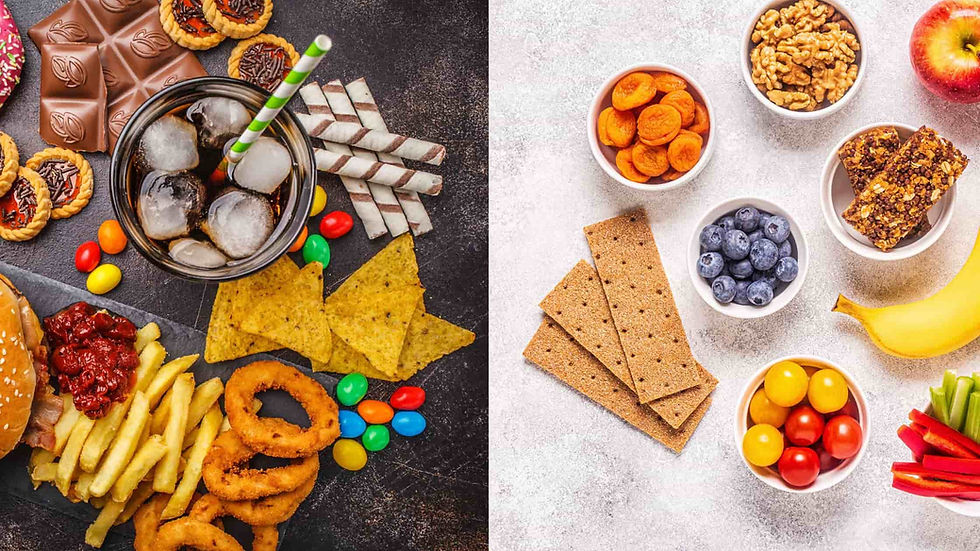
Many of us consider ourselves “snackers”. Research suggests that around 25% of our daily calories may come from snacks alone. That is a significant portion of our daily food intake — not just nutritionally, but also metabolically.
How Snacking Culture Has Changed
Growing up in the 1980s and early 1990s, things looked very different. Petrol stations mainly sold petrol. Grocery stores had limited options for portable snack foods. Eating while walking, driving simply wasn’t common for most people.
Today, food is available everywhere:
petrol stations,
supermarkets,
office kitchens,
vending machines,
cafés,
airports,
gyms,
etc.
Modern food environments constantly encourage us to eat “on the go.” Convenience foods and snack marketing are now deeply embedded into daily life. While it may not be realistic to completely eliminate snacking, we can absolutely make better choices around what we snack on and why we snack.
Is Snacking Really a Problem?
Not necessarily.
Snacking itself is not automatically unhealthy. In fact, snacks can sometimes help support energy levels, concentration, blood sugar balance, and nutrient intake.
The bigger question is: What are we snacking on, how often, and why?
Many modern snacks are highly processed and designed to be hyper-palatable — rich in sugar, salt, refined carbohydrates, unhealthy fats, and additives, while being low in fibre, protein, vitamins, and minerals. These foods are often easy to overeat and may leave us unsatisfied shortly after eating them.
What Happens in the Body When We Graze All Day?
From a biological perspective, constant grazing can affect several systems in the body.
Every time we eat — especially foods and drinks rich in refined carbohydrates and sugar — our blood sugar levels rise. In response, the pancreas releases insulin to help move glucose into cells.
If we snack continuously throughout the day, especially on ultra-processed foods, the body may remain in a more constant “fed state.” This can lead to:
more frequent blood sugar spikes and crashes,
increased cravings,
difficulty recognising true hunger and fullness signals,
overeating later in the day,
and in some individuals, poorer metabolic health over time.
Constant grazing may also reduce the digestive system’s natural rest periods. Some research suggests that late-night snacking in particular may negatively impact blood sugar regulation and blood fat levels.
However, context matters. A handful of nuts and berries is metabolically very different from repeatedly eating sweets, pastries, crisps, or sugary drinks throughout the day.
Before We Blame Snacks — Let’s Look at Main Meals
One of the most important questions is: Are our main meals actually satisfying and balanced enough?
Breakfast, lunch, and dinner should provide enough total energy for our needs and ideally include a balance of:
protein,
healthy fats,
fibre-rich carbohydrates

When meals are balanced and nourishing, many people naturally feel less need to snack constantly. But when meals are low in protein, low in fibre, or insufficient overall, hunger quickly returns.
For example:
A breakfast of sugary cereal or toast with jam may digest quickly and leave us hungry within a couple of hours.
A lunch consisting of a hot dog, pastry, or processed convenience food may lack protein, fibre, and micronutrients, leading to energy crashes and strong cravings later in the day.
This often creates a cycle of:
under-fuelling earlier in the day,
intense hunger later,
overeating in the evening,
followed by more cravings and snacking.
In many cases, improving meal quality naturally reduces excessive snacking.
Sometimes the Problem Isn't Food
If you find yourself constantly craving snacks, it may be worth looking beyond your diet.
Poor sleep can increase hunger, reduce appetite control and increase cravings for sugary and highly processed foods.
Stress can have similar effects, leading many people to reach for convenient comfort foods.
Sometimes improving sleep habits and stress management can reduce the urge to snack far more effectively than relying on willpower alone.
Who Might Benefit From Snacks?
Not everyone needs snacks between meals. For some people, three balanced meals per day may be perfectly adequate. For others, snacks can play an important role in helping meet energy and nutrient needs.
People who may genuinely benefit from snacks between meals include:
growing children and teenagers,
athletes and physically active individuals,
people with high energy needs,
individuals with long gaps between meals,
older adults with smaller appetites,
pregnant or breastfeeding women,
people recovering from illness, injury, or surgery,
and some individuals who benefit from spreading their food intake more evenly throughout the day.
For active children, teenagers, and athletes, snacks can provide additional energy, protein, and nutrients needed for growth, recovery, and performance.
For older adults, nutrient-dense snacks may help support adequate protein and energy intake when larger meals become more difficult to consume.
The goal is not to fear snacks — but to make them more nourishing and intentional.
Why Are We Reaching for Snacks?
Not all snacking is driven by physical hunger.
Many of us snack because:
we're stressed
we're tired
we're bored
food is visible and easily available
we're taking a break from work
everyone around us is eating
Before reaching for a snack, it can be helpful to pause and ask yourself:
Am I physically hungry?
Am I thirsty?
Am I stressed or overwhelmed?
Am I simply looking for a break?
Learning to distinguish physical hunger from emotional or environmental triggers can help us make more intentional food choices.
The Real Problem: Snack Quality
The issue is often not the snack itself, but the quality of the snack. If roughly 25% of our calories come from snacks, then those foods have a major impact on:
energy levels,
nutrient intake,
gut health,
blood sugar balance,
heart health,
concentration,
and long-term wellbeing.
A snack that contains protein, fibre, and healthy fats can help stabilise energy and support fullness. A snack built mostly from sugar, refined starch, and highly processed ingredients may do the opposite.
For example:
an apple with almonds
a fruit juice with a cereal bar
Both snacks may provide similar calories, yet the first snack contains significantly more fibre and protein, which often helps keep us fuller for longer.
Focusing on whole and minimally processed foods can help make snacks more satisfying and nutritious.
What the ZOE Snacking Research Found
Interestingly, there is still surprisingly little research specifically on snacking. Researchers at ZOE decided to investigate this further in their own snacking study.
Their findings were fascinating:
The number of snacks and snack calories alone did not strongly predict poor health outcomes.
Instead, low-quality snacks were associated with worse health markers.
Late-night snacking (especially after 9pm) was linked with poorer blood sugar control and higher blood fat levels.
Overall, the message was encouraging: You do not necessarily need to stop snacking — but you may benefit greatly from snacking smarter. Eating nutrient-dense snacks earlier in the day may have very different effects compared with regularly eating high-calorie snacks late in the evening.
Snacks Can Feed More Than Just You
Every snack is an opportunity to nourish your gut microbiome.
Foods such as berries, nuts, seeds, beans, chickpeas, vegetables and fermented foods provide fibre and plant compounds that help support a diverse and healthy gut ecosystem.
Rather than seeing snacks simply as calories between meals, we can view them as opportunities to increase plant diversity and support long-term digestive and overall health.
Healthy Snacks Should Ideally Include…
The most satisfying snacks contain a combination of:
For example:
apple + nuts,
yoghurt + berries + seeds,
hummus + vegetables,
rye bread + egg,
kefir smoothie with chia seeds.
These combinations tend to support:
steadier blood sugar,
improved fullness,
better concentration,
and reduced cravings later in the day.
25 Smarter Snack Swaps
Small swaps repeated daily can make a surprisingly large impact on health, energy, cholesterol levels, gut health, and blood sugar balance.
Instead of… | Try swapping to… |
Milk chocolate bar | Dark chocolate (70%+ cacao) with nuts |
Crisps/potato chips | Roasted nuts or roasted chickpeas |
Sugary breakfast bar | Apple with nut butter |
Sweetened yoghurt | Plain Greek yogurt with fresh or frozen berries |
Pastries | Boiled eggs with vegetables |
Ice cream | Greek yoghurt with frozen berries, or cottage cheese blended with frozen berries |
Candy | Dates with nuts |
Sugary cereal snack | |
White bread sandwich | Rye bread with hummus or avocado and salmon |
Sugary iced coffee | Coffee with milk and nuts on the side |
Energy drink | Sparkling water with berries/citrus or 150ml of kombucha |
Sugary smoothie | Homemade protein-rich smoothie with seeds |
Cookies | Homemade cookies, like these hempseed and banana cookies |
Cinnamon bun | Homemade muffins, why not try and make blueberry muffins |
Processed protein bar | Handful of nuts and fruit or make your own protein bars |
Sweetened granola | Plain oats with yoghurt and berries or make your own granola at home |
Sugary soft drink | Kombucha or sparkling water |
Fast-food milkshake | Kefir smoothie |
Rice cakes | Seed crackers with hummus |
Processed cheese snacks | Cottage cheese with cucumber or vegetable sticks (carrot, celery, paprika, kohlrabi) with a bean dip |
Sugary puddings | Chia pudding with berries |
Fried snack foods | Edamame beans |
Processed deli snack | Cooked chicken slices with veggies |
Sugary bubble tea | Unsweetened tea with fruit |
Drive-through snack meal | Homemade snack box with eggs, veggies, hummus, nuts |
Questions Worth Asking Yourself
Instead of aiming for perfection, simply becoming more aware of your habits can already make a big difference.
Ask yourself:
Could I add more protein to my snack? (for example Greek yoghurt, cottage cheese, eggs, kefir, nuts, seeds, hummus or leftover chicken)
Could I increase fibre in my snacks? (berries, vegetables, fruit, rye bread, oats, seeds, beans, chickpeas)
Could I reduce ultra-processed snack foods? (less candy, pastries, crisps, sugary drinks, highly processed bars and packaged snacks)
Could I prepare one better option ahead of time? (boiled eggs, chopped vegetables, overnight oats, homemade trail mix of nuts, seeds and dried fruit, yoghurt pots with berries and chia seeds, roasted chickpeas)
Even changing just one or two snack habits per day can have a meaningful impact over time.
Snacking Smarter — Not Perfectly
Snacking is likely here to stay in modern society. The goal is not perfection or restriction.
The goal should be awareness.
When we begin to understand:
why we snack,
what our bodies truly need,
and how different foods affect our energy, mood, concentration, hunger, and long-term health,
we can make choices that genuinely support wellbeing.
Every snack is an opportunity to add something beneficial to your diet. Rather than focusing only on what to avoid, consider what you could add: more protein, more fibre, more plant diversity, more healthy fats, or more fermented foods. Small improvements made consistently over time can have a meaningful impact on energy, gut health, blood sugar balance, heart health and overall wellbeing.
Sometimes the smallest habits — repeated daily — have the biggest impact.
If you are looking to improve your nutrition to support your health goals, whether it's to loose weight, have more energy and mental clarity, better digestive health, skin health, cardiovascular health, don't hesitate to reach out to me for personal nutrition counselling at info@katrinpeo.com.


Comments