


Beyond Calories: How the Food Matrix Shapes Your Health
We often judge food by its nutrition label—but our bodies don't.
When choosing what to eat, many of us look at the nutrition label first.
How many calories does it contain?
How much protein, fat or carbohydrate?
How much sugar?
While these numbers are useful, they don't tell the whole story.
Our bodies don't simply "read" nutrition labels. Instead, they respond to something scientists call the food matrix—the physical structure of food and the way nutrients are packaged together within it.
The food matrix influences how quickly food is digested, how full we feel afterwards, how much our blood sugar rises, how many nutrients we absorb and even how much energy our bodies extract from the food.
This helps explain why two foods with very similar nutrition labels can affect our bodies quite differently.

What is the food matrix?
The food matrix refers to the natural structure of a food and the way its nutrients are organised within plant or animal tissues.
Rather than existing as isolated nutrients, carbohydrates, proteins, fats, vitamins and minerals are enclosed within cells and surrounded by fibres, water, proteins and other naturally occurring compounds.
When we eat, our digestive system must first break down this structure before nutrients become available for absorption.
The more intact a food remains, the more work our digestive system needs to do. When foods are chopped, blended, ground or refined, parts of this natural structure are broken down, making nutrients easier—and often faster—to access.
This is one reason why the structure of food matters just as much as its nutrient content.
Calories don't always tell the whole story
Many people assume that if a food label states 200 calories, their body absorbs exactly 200 calories.
In reality, the amount of energy we obtain from food—known as metabolisable energy—can vary depending on the food's structure.
Chewing, digestion, the gut microbiome and the degree of food processing all influence how much energy is ultimately available to our bodies.
For example, some nutrients remain trapped within intact plant cell walls and pass through the digestive system without being fully absorbed. When these cell walls are broken down through grinding or blending, more nutrients become accessible.
In other words, two foods containing the same number of calories on paper may not provide exactly the same amount of usable energy to the body.
Whole fruit, smoothies and fruit juice: the same fruit, different effects
A whole apple, an apple smoothie and apple juice may all originate from the same fruit, but their effects on the body differ considerably.
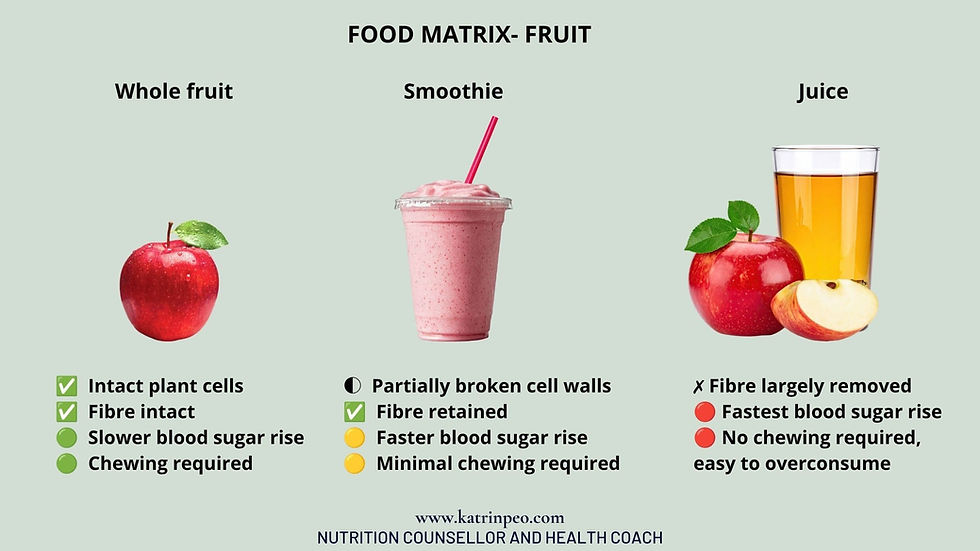
When you eat a whole apple, you need to chew it. The fruit's cell walls remain largely intact, and its fibre slows digestion and the release of glucose into the bloodstream. This results in a more gradual rise in blood sugar and helps you feel fuller for longer.
When the apple is blended into a smoothie, many of the plant cells are broken open. Although the fibre is still present, nutrients become more readily available, allowing faster digestion compared with eating the fruit whole.
This doesn't mean smoothies are unhealthy. Smoothies can be a nutritious option, particularly when they include vegetables (such as spinach, kale), protein sources such as Greek yoghurt or kefir, and healthy fats from nuts or seeds. However, from a metabolic perspective, they are not identical to eating whole fruit.
Juicing goes one step further. Most of the fibre is removed, leaving the naturally occurring sugars to be absorbed much more rapidly. This typically causes a quicker rise in blood sugar and provides less satiety than eating whole fruit.
Whole nuts versus nut butter
Nuts provide one of the best examples of how the food matrix affects calorie absorption.
Although nuts are rich in healthy unsaturated fats, our bodies do not absorb all of the fat they contain. This is because much of the fat remains enclosed within intact plant cells, and chewing alone cannot completely break down these cell walls.
As a result, some of the fat passes through the digestive tract without being absorbed.
When nuts are ground into nut butter, however, the cell walls are largely destroyed. This makes the fat much more accessible during digestion, allowing the body to absorb more of the available energy.
This doesn't mean nut butter should be avoided. Both whole nuts and nut butters are nutritious foods rich in healthy fats, fibre, vitamins and minerals. The important point is that the same food can behave differently depending on its physical structure.
Steel-cut oats, rolled oats and instant oats
Oats are another excellent example of how food processing changes the food matrix.
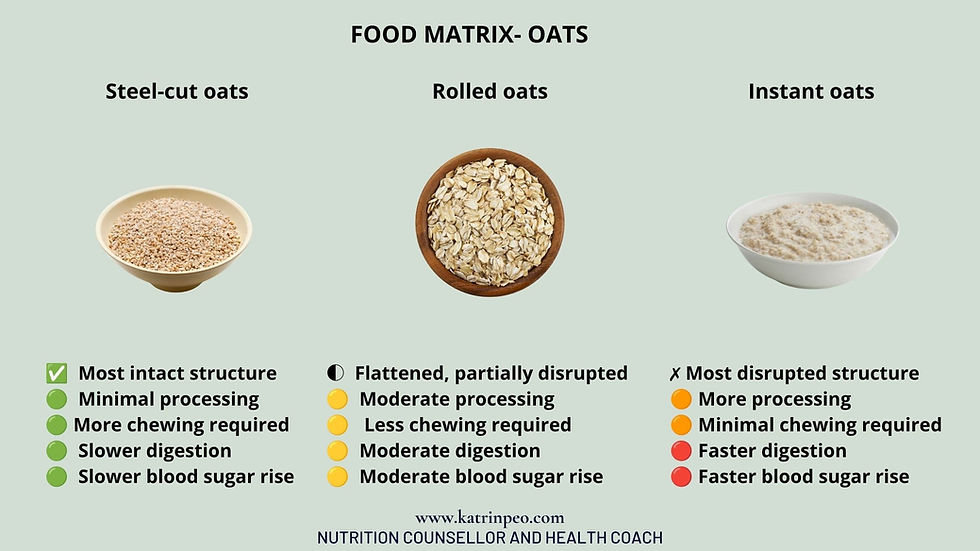
Steel-cut oats are simply oat groats cut into smaller pieces while retaining much of their original structure. Because they require more chewing and take longer to digest, they generally produce a slower rise in blood sugar.
Rolled oats have been steamed and flattened, making them quicker to cook and easier to digest.
Instant oats undergo even more processing. Their smaller particle size allows digestive enzymes to access the starch more rapidly, often leading to a higher and faster blood sugar response.
All forms of oats remain nutritious and provide valuable fibre, particularly beta-glucan. However, the more intact the oat, the slower its digestion tends to be. And of course it also depends what you add to your oats when you cook them (jam or honey; or seeds, mushrooms and nutritional yeast for example), how the meal will impact your blood sugar.
Whole grains versus flour
The same principle applies to grains.
Eating intact grains such as barley, rye berries or wheat berries requires more chewing and digestion than eating foods made from the flour of the same grains.
Grinding grains into flour breaks apart much of their natural structure, allowing digestive enzymes easier access to the starch.
Even wholemeal flour behaves differently from intact whole grains because the food matrix has already been disrupted.
The dairy matrix: why nutrients don't always act alone
The food matrix doesn't only apply to plant foods.
Research has shown that foods containing similar amounts of saturated fat can affect health differently depending on their structure.
For example, cheese and butter both contain saturated fat, yet cheese generally has a smaller effect on raising LDL ("bad") cholesterol than butter.
Scientists believe this is partly due to the dairy matrix—the complex interaction between calcium, protein, fat globules and fermentation within cheese—which influences how fat is digested and absorbed.
This reminds us that focusing on a single nutrient in isolation doesn't always reflect how food behaves in the body.
More chewing may benefit your metabolism
Whole foods generally require more chewing than highly processed foods.
Chewing is the first stage of digestion and stimulates the release of digestive enzymes and hormones involved in appetite regulation.
More intact foods also require slightly more energy to digest, absorb and metabolise—a process known as the thermic effect of food (TEF).
Although the difference in calorie expenditure is relatively modest, it adds to the many reasons why minimally processed foods tend to promote greater fullness than foods requiring little chewing.
Your gut microbes also benefit from an intact food matrix
If you have been reading my blog over the years, you know that not all carbohydrates are digested in the small intestine.
When plant cell walls remain intact, some fibre and resistant starch reach the large intestine, where they are fermented by beneficial gut bacteria.
This fermentation produces short-chain fatty acids, including butyrate, which help maintain the gut lining, support immune function and may reduce inflammation.
Highly processed foods often provide fewer opportunities for this beneficial fermentation because much of the natural food structure has already been broken down.
Processing isn't always bad
It's important not to think of food processing as simply "good" or "bad."
Many minimally processed foods remain highly nutritious and make healthy eating easier.
These include:
Frozen vegetables and fruit
Canned beans and lentils (preferably low in salt or rinsed before use)
Plain yoghurt and kefir
Pasteurised milk, if tolerated
Steel-cut or rolled oats
Frozen berries
Extra virgin olive oil
Frozen fish
In many cases, processing improves food safety, extends shelf life, reduces food waste and makes nutritious foods more accessible.
The key question isn't whether a food has been processed—it is how much the natural food matrix has been altered and whether beneficial nutrients have been removed or undesirable ingredients added.
When the food matrix is almost completely lost
At the other end of the spectrum are many ultra-processed foods, where the original food matrix has been largely broken down and transformed into an entirely new product. Instead of whole foods, these products are typically made from refined ingredients such as starches, flours, sugars, vegetable oils and isolated proteins, combined with flavourings, colourings, emulsifiers, artificial sweeteners and other additives to create a product with a long shelf life and a consistent taste and texture. Examples include sugary breakfast cereals, confectionery, crisps, soft drinks, many packaged cakes and biscuits, sweetened breakfast bars, instant noodles, chicken nuggets, flavoured snack foods and many fast-food items.
These foods are often soft, require little chewing and are digested quickly, making them easy to eat rapidly and in large amounts before our body's natural fullness signals have time to respond. Many are carefully formulated to combine fat, refined carbohydrates, sugar and salt in ways that make them highly palatable and encourage people to keep eating. This doesn't mean they need to be completely avoided, but diets dominated by ultra-processed foods have consistently been associated with a higher risk of weight gain and several chronic diseases. In contrast, meals based primarily on whole or minimally processed foods generally require more chewing, promote greater satiety and better preserve the natural food matrix that supports healthy digestion and metabolism.
The concern isn't that foods have been processed—it is when processing fundamentally changes the food's natural structure and how our bodies respond to it.
When softer or liquid foods are the better choice
Although whole foods offer many advantages, there are situations where softer or liquid foods are medically necessary or more appropriate.
Examples include:
Recovery after jaw or gastrointestinal surgery
Early stages following bariatric surgery
Difficulty swallowing (dysphagia)
Stroke rehabilitation
Head and neck cancers
Severe mouth ulcers or dental problems
Older adults with significant chewing difficulties
Certain digestive conditions during acute flare-ups, when advised by a healthcare professional
In these situations, modifying food texture helps ensure adequate nutrition and supports recovery.
For individuals without these medical needs, however, choosing foods that retain much of their natural structure is generally associated with greater satiety, slower digestion and better overall metabolic health.
Practical ways to preserve the food matrix
You don't need to avoid processed foods entirely. Instead, aim to include more foods that retain much of their natural structure.
Some simple ways to do this include:
Choose whole fruit majority of the time and leave fruit juice for occasional consumption if desired.
Enjoy smoothies as a meal or snack rather than replacing all whole fruit with smoothies. Make sure your smoothies contain a source of protein, fibre and healthy fats to make them more satiating.
Include more whole nuts alongside nut butters.
Choose steel-cut or rolled oats more often than instant oats.
Eat intact whole grains such as barley, rye berries or quinoa regularly.
Include beans, lentils and vegetables in most meals.
Focus on your overall dietary pattern rather than individual nutrients or calorie counts.
Key take-home message
Calories are important, but they don't tell the whole story.
The way food is structured influences how quickly it is digested, how full we feel, how our blood sugar responds, how many nutrients become available and even how much energy our bodies ultimately absorb.
Rather than focusing solely on calories or individual nutrients, consider the food as a whole. Choosing foods that retain much of their natural structure—such as fruits, vegetables, legumes, intact whole grains, nuts and seeds—supports a slower, more gradual release of nutrients and provides many benefits for metabolic and long-term health.
The food matrix reminds us that food is far more than the sum of its nutrients. Sometimes, how food is packaged by nature is just as important as what it contains.
References
Fardet A. Minimally Processed Foods Are More Satiating and Less Hyperglycemic Than Ultra-Processed Foods: A Preliminary Study with 98 Ready-to-Eat Foods. Food & Function. 2016.
Fardet A, Rock E. Perspective: Reductionist Nutrition Research Has Meaningfully Nourished the Food Matrix Concept. Advances in Nutrition. 2022.
Novotny JA, Gebauer SK, Baer DJ. Discrepancy Between the Atwater Factor Predicted and Empirically Measured Energy Values of Almonds. American Journal of Clinical Nutrition. 2012.
Baer DJ, Gebauer SK, Novotny JA. Walnuts Consumed by Healthy Adults Provide Less Available Energy Than Predicted by the Atwater Factors. Journal of Nutrition. 2016.
The Lancet: Ultra-Processed Foods and Human Health


Comments