


Nutri-Score on Food Packaging: Could a Simpler Label Help Us Make Healthier Choices?
Why do we need easier tools to navigate food choices?
Every week, we make dozens of decisions in the supermarket.
Which yoghurt should I choose? Which bread is a better option? Are there any breakfast cereals that are healthier than others? Does a product labelled “high in protein” or “high in fibre” automatically mean it is a better choice?
We often like to believe that our food choices are fully conscious decisions: we read labels, compare prices and think about our health.
However, behavioural science shows that our decisions are also influenced by many other factors – the way products are placed on shelves (and where), promotions, packaging colours, advertising, habits and even how tired or rushed we are when shopping for groceries.
Recently, I listened to a discussion between behavioural psychologist Andero Uusberg and family doctor Marta Velgan in the Estonian podcast Kaalujutud. They discussed an important point: choosing healthier food is not only about having knowledge. It is also about the environment in where we make our choices.
This raises an important question:
How can we make healthier choices easier for consumers?
One possible tool used in several European countries is Nutri-Score – a front-of-pack nutrition label designed to help consumers quickly understand the overall nutritional quality of packaged foods.
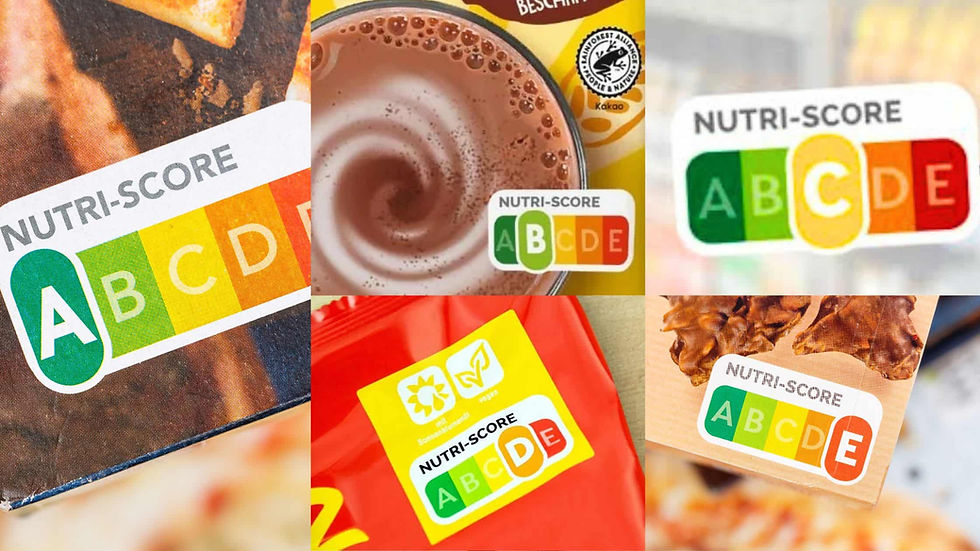
What is Nutri-Score?
Nutri-Score is a voluntary front-of-pack nutrition labelling system that gives food products a rating from A to E.
A (dark green) indicates products with a more favourable nutritional profile according to the Nutri-Score algorithm.
E (red) indicates products with a less favourable nutritional profile compared with other products in the same category.
The system is not designed to tell people whether a food is simply “healthy” or “unhealthy”. Nutrition is much more complex than applying a single letter. A healthy diet is based on the overall eating pattern – not on one individual product.
Nutri-Score is also not intended to compare products in completely different food groups. For example, the purpose is not to compare olive oil with an apple or fish with yoghurt.
Instead, it is designed to help consumers compare similar products, such as:
one breakfast cereal versus another;
one yoghurt versus another;
different types of bread.
How was Nutri-Score developed?
Nutri-Score was developed in France in collaboration with public health and nutrition researchers.
The system is based on a scientific nutrient profiling model that evaluates the nutritional composition of foods.
The algorithm considers factors such as:
The system has been evaluated in scientific studies and has also been updated over time as nutrition science evolves.
Importantly, Nutri-Score is not meant to replace nutrition education. Its purpose is to provide a simple orientation tool in situations where consumers have only a short time to make decisions.
Where is Nutri-Score used?
Nutri-Score is currently used in several European countries, including:
France (since 2017);
Belgium (2018);
Spain (2018);
Germany (2019);
Switzerland (2019);
Netherlands (2019);
Luxembourg (2020).
Within the European Union, Nutri-Score is not mandatory. Food companies can voluntarily choose whether to use it on their products.
Why is existing nutrition information not enough?
European food labels already provide detailed nutrition information. Consumers can see:
calories;
fat;
carbohydrates;
sugars;
protein;
salt.
However, having information available does not always mean that people can easily use it.
Understanding whether 5 grams of sugar per 100 grams is high or low, or whether one product contains meaningfully more fibre than another, requires a certain level of nutrition literacy.
In addition, packaging information is often written in very small print, making it difficult to compare products quickly while standing in a supermarket aisle.
The idea behind Nutri-Score is to make key information more visible and easier to understand.
Does Nutri-Score change consumer behaviour?
Research suggests that simplified front-of-pack labels can help consumers better understand the nutritional quality of products and may support healthier purchasing decisions.
However, it is important to be realistic. No single label can solve complex public health challenges such as obesity, chronic diseases or unhealthy dietary patterns.
Food choices are influenced by many factors:
food prices;
income;
availability;
culture;
taste preferences;
family habits;
cooking skills.
Nutri-Score is one possible tool among many.
What are the limitations of Nutri-Score?
Like any simplified system, Nutri-Score has limitations.
One important point is that Nutri-Score does not directly evaluate the degree of processing of food.
This means that some ultra-processed products may receive a favourable rating if their nutrient composition meets the criteria of the algorithm.
This highlights an important principle in nutrition:
No single label can replace broader food literacy.
The foundation of a health-supportive diet is consuming unprocessed or minimally processed foods, such as:
vegetables;
fruits and berries;
legumes;
whole grains;
nuts;
seeds;
fish;
other foods close to their natural form.
Nutri-Score can be considered an additional tool, especially when comparing packaged products within the same food category.
Other front-of-pack food labelling systems around the world
Nutri-Score is not the only system designed to support healthier food choices.
Different countries have developed different approaches.
Used in Australia and New Zealand, this system gives packaged foods a star rating based on their nutritional profile.
Used in Nordic countries, this label identifies products that meet certain criteria for lower salt, sugar and fat content and higher fibre content compared with similar products.
Warning labels
Countries such as Chile and Mexico use warning labels that highlight products high in sugar, salt, saturated fat or calories.
The common goal of these systems is the same: to make healthier choices easier for consumers.
The situation in Estonia
Nutri-Score has recently become a topic of active discussion in Estonia.
The Estonian Society of Nutrition Advisors and Therapists (ESNAT), together with the Estonian Association of Family Nurses, submitted a public appeal to the government in June 2026, highlighting the need to make food information easier for consumers to understand.
The Estonian Society of Paediatrics has also expressed its views on the topic.
At the same time, there have also been critical opinions, particularly concerning whether a simplified label can fully represent the complexity of food quality.
This discussion is important because decisions affecting public health require input from many perspectives:
scientists;
healthcare professionals;
policymakers;
food producers;
consumers.
My perspective as a nutrition counsellor /nutrition advisor
I am a certified nutrition counsellor/nutrition advisor and a board member of the The Estonian Society of Nutrition Advisors and Therapists.
My own approach to nutrition starts with whole foods.
The majority of my shopping basket consists of:
vegetables;
fruits and berries;
fish;
meat;
dairy products;
legumes;
whole grains;
nuts and seeds.
These foods are often naturally nutritious and do not require complicated labels.
I also choose minimally processed packaged foods where appropriate, such as:
wholegrain pasta;
wholegrain bread;
canned legumes;
olive oil;
canned fish;
plain yoghurt;
kefir;
cottage cheese;
frozen berries and vegetables.
However, in supermarkets we also often need to choose between different packaged products where the ingredients and nutritional information are not always easy to interpret.
This is where a simple, visible label could potentially help.
It is also important to remember that marketing claims on packaging do not automatically mean that a product is the best choice.
A product may say:
“high in protein”;
“high in fibre”;
but we should still look the details on product label:
What are the ingredients?
What type of fibre does it contain?
How much fibre is actually present?
How much added sugar, salt or saturated fat does it contain?
Could Nutri-Score help consumers in Estonia?
In my view, Nutri-Score should not be seen as a magic solution or as a system telling people what they should or should not eat.
For consumers it is important to be able to choose according to their preferences, circumstances and needs.
However, if consumers have access to clearer information that helps them make more informed choices more easily, this can be a positive step.
Behavioural science shows that small changes in the environment can influence decisions.
For example, making healthier choices more visible and easier to identify can support better decisions without restricting personal freedom.
Public health improvements rarely come from one single solution. They come from many small steps. Nutri-Score could be one of those steps – a tool that helps make healthier choices a little easier.
Discussion at Arvamusfestival 2026
The Estonian Society of Nutrition Advisors and Therapists is organising a discussion at Arvamusfestival 2026 (08.08.2026):
“Is Nutri-Score a lifeline for public health or simply another label on food packaging?”
The discussion will bring together representatives from healthcare, science, politics, government and the food industry to explore different perspectives on food labelling and healthier choices:
Elle-Mall Sadrak – President of the Estonian Society of Family Physicians
Uku Vainik – Professor of Behavioural Genetics, Institute of Psychology, University of Tartu
Ene Viiard – Food Scientist and representative of The Estonian Society of Nutrition Advisors and Therapists
Taavi Tillmann – Associate Professor of Public Health, University of Tartu
Riina Sikkut – Member of Parliament / politician
Hellika Kallaste – Representative of the Ministry of Regional Affairs and Agriculture
Janne Laik-Lõhmus – Representative of the food industry
The shared goal, I hope, is simply:
to help people make easier, better-informed choices and support a healthier future for society.
References:
Consumer understanding of Nutri-Score and comparison with other front-of-pack labels
(Egnell M, Ducrot P, Touvier M, et al. (2018). Objective understanding of Nutri-Score Front-Of-Package nutrition label according to individual characteristics of subjects: Comparisons with other format labels.)
(Egnell M, Galan P, Farpour-Lambert NJ, et al. (2020). Compared to other front-of-pack nutrition labels, the Nutri-Score emerged as the most efficient to inform Swiss consumers on the nutritional quality of food products
The impact of Nutri-Score on purchasing decisions
(Egnell M, Boutron I, Péneau S, et al. (2019). Front-of-Pack Labeling and the Nutritional Quality of Students' Food Purchases: A 3-Arm Randomized Controlled Trial.
Chantal M, Hercberg S, Julia C. (2020).
Nutri-Score: A Useful Tool to Improve the Nutritional Quality of Food Purchases? International Journal of Nutrition and Food Sciences.


Comments