


Nutri-Score in Estonia: If Not Now, Then When? We Need Decisions That Put Public Health First
On November 10, 2026, I attended a seminar organised by the Estonian Ministry of Regional Affairs and Agriculture entitled “Nutri-Score in the Estonian Food Market – Opportunities, Impacts and Next Steps.”
The seminar featured three presentations. Mirel Mesila discussed how the Nutri-Score labelling system aligns with Estonia's national dietary guidelines. Kristian Pentus presented interim findings from an eye-tracking study exploring how consumers interact with different front-of-pack nutrition labels. Anneli Saaroja examined the potential economic impact of introducing Nutri-Score on a voluntary basis.
I left the seminar feeling somewhat unsettled. Not because I believe Nutri-Score is a perfect solution, or that introducing it would solve Estonia's nutritional challenges. Rather, I found myself wondering how much we focus on potential impacts, risks, costs and alternatives, while perhaps not giving enough attention to a much bigger question:
What kind of future do we want for the health of the Estonian population?

Public health versus economic interests
One of the seminar presentations clearly outlined which organisations support the voluntary introduction of Nutri-Score in Estonia and which have expressed opposition or reservations.
The organisations supporting its introduction include:
Estonian Society of of Nutrition Advisors and Therapists (ESNAT)
Researchers from the Institute of Psychology at the University of Tartu
Estonian Society of Endocrinology
Organisations listed as opposing or critical of the proposal include:
On one side, we have organisations whose work is closely connected to people's health, disease prevention and public health promotion. They meet people face to face, work with patients and consumers, and see the health challenges facing Estonian society every day.
On the other side, we have organisations representing food producers, agriculture and the wider business sector, for whom production costs, competitiveness and economic sustainability are also important considerations.
My first thought was: here we have health and economic interests sitting side by side.
I am not suggesting that the concerns of businesses should be ignored. Of course, we need to consider implementation costs, potential effects on product development and competitiveness. However, we also need to ask ourselves what the long-term interests of our country are.
Are we looking only at the potential costs businesses may face in the coming years, or are we also considering the costs society will bear if the health of our population continues to deteriorate?
What is the state of public health in Estonia?
According to the National Institute for Health Development's 2024 Health Behaviour among Estonian Adult Population survey, 52% of adults aged 16–64 were overweight or living with obesity.
The situation among children is equally concerning.
The National Institute for Health Development's 2022 study of schoolchildren's growth and health included almost 18,000 children from 203 schools. It found that 31% of children in grades 1, 4 and 7 had excess body weight. That means approximately one in three boys and one in four girls.
These are not just statistics. Behind these numbers are real people, families and future adults.
Excess body weight is not simply a matter of appearance or weight. It is associated with an increased risk of developing type 2 diabetes, cardiovascular disease and several other chronic conditions. It can affect quality of life, working ability and the number of years people live in good health.
We are already paying for these consequences, and we will continue to pay for them in the future – through healthcare expenditure, reduced work capacity, preventable illness and diminished quality of life.
This is why we need to focus much more on prevention, rather than simply dealing with the consequences later.
What has Estonia actually done over the past decade?
It would be unfair to suggest that nothing has been done in Estonia to promote healthier eating. There have been several initiatives.
Estonia has developed a Green Paper on Nutrition and Physical Activity (which has not yet received formal approval from the Estonian Government), updated its national dietary recommendations, introduced free school lunches and implemented programmes supporting the availability of fruit and vegetables in schools.
In 2017, the Estonian Parliament adopted legislation introducing a tax on sugar-sweetened beverages. However, the law did not come into force after the President declined to promulgate it. A new sugar-sweetened beverage tax proposal was introduced in 2024, but this initiative also did not result in implementation.
School catering is another area where progress is needed. In 2024, the National Institute for Health Development highlighted the need to modernise the regulations governing food served in schools and kindergartens, which largely date back to 2008, to reflect updated dietary recommendations. The modernised catering regulations for schools and kindergartens took effect in September 2025, with strict limits fully enforced in September 2026.
We have knowledge, research and recommendations. What we need is consistency and the determination to put them into practice.
What could we learn from other countries?
Norway and Sweden for example have higher healthy life expectancy figures than Estonia. This gives us a reason to examine how these countries approach public health promotion, prevention and food policy.
Japan offers another particularly interesting example, especially when it comes to school meals and nutrition education.
In Japan, school meals are part of a broader food and nutrition education system known as Shokuiku. Under Japan's School Lunch Act, nutrition education is an important objective of school meal programmes.
Schools employ specially trained nutrition teachers who contribute to:
Planning school menus and assessing their nutritional value.
Working with school cooks and catering staff.
Educating children about nutrition.
Teaching children about where food comes from and how it is prepared.
Integrating food and nutrition education into everyday school life.
Children also participate in serving meals and cleaning up afterwards, learning about food, its origins and its role in health.
This is an interesting approach because school meals are not viewed simply as food provided during the school day. They are also an opportunity to educate children and develop lifelong habits.
Could we introduce more practical cooking lessons in Estonian schools?
Could children learn from an early age how to prepare balanced meals using real ingredients, including vegetables, legumes, whole grains and fish?
Could they learn not only about nutrition in theory, but also how to prepare, taste and understand different foods?
Could we have more nutrition professionals supporting schools, helping catering teams, teachers and children develop a better understanding of food and nutrition?
These would be investments whose benefits could extend far beyond a single school year.
Nutri-Score is not perfect. Does that mean we should do nothing?
The research presented at the seminar showed that Nutri-Score generally aligns with Estonia's national dietary recommendations, although there are some exceptions.
For example, 15 out of 17 cheeses analysed received a D or E rating. Some high-protein desserts, on the other hand, received an A rating, even though they belong to a category that our national dietary recommendations generally classify among foods to be consumed less frequently.
This demonstrates that Nutri-Score cannot replace comprehensive dietary recommendations.
It does not assess portion sizes, frequency of consumption, the overall degree of food processing or a person's entire dietary pattern.
But that is not its purpose.
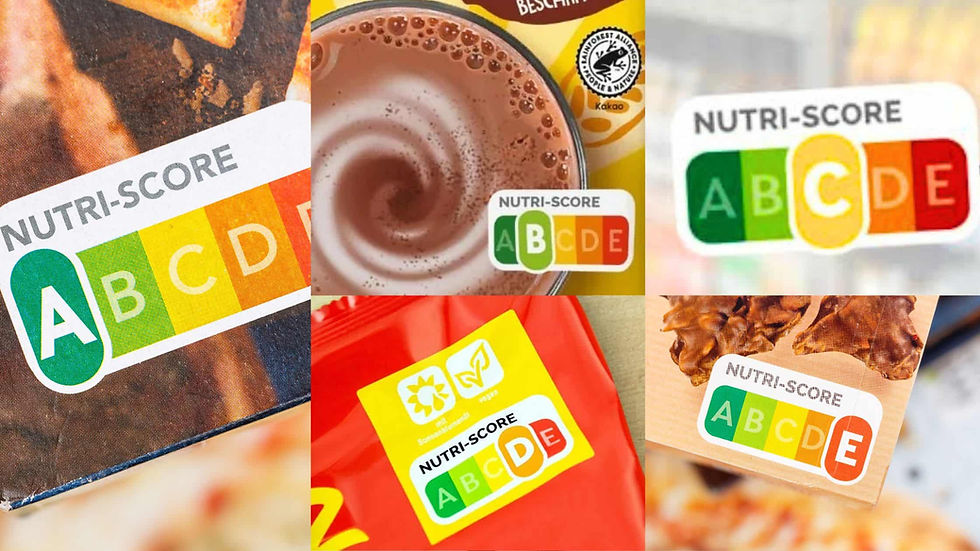
Its purpose is to provide consumers with an easier way to understand and compare the nutritional composition of packaged food products.
The interim findings presented by Kristian Pentus from the eye-tracking study also offered interesting insights. In the laboratory experiment, products with a more favourable nutritional profile were selected more frequently. This association was stronger with Nutri-Score than with the two other labelling systems being compared.
Of course, further research is needed to establish whether these findings translate into actual purchasing behaviour in supermarkets.
I believe it is important to understand that a labelling system does not have to be perfect to be useful. However, consumers need to understand what it tells them and, equally importantly, what it does not tell them.
If certain food categories require more attention within the algorithm, we can provide feedback to the Nutri-Score scientific team responsible for its development and contribute to further improvements.
Can we afford to wait another four or five years?
On 10 November, the day of the seminar, it became clear that Estonia's Ministry of Economic Affairs and Industry had not approved the draft legislation allowing the voluntary introduction of Nutri-Score.
The ministry requested further analysis of alternative labelling systems, concerns raised by businesses and potential economic impacts.
I understand the need to address these questions. However, I hope that analysing alternatives will not mean another prolonged period during which we fail to take any additional steps.
The proposed introduction of Nutri-Score is voluntary. It would not oblige all manufacturers to display the label or solve all of Estonia's nutritional challenges.
However, it would give consumers an additional tool to make more informed choices when shopping.
At the same time, we can and should address food affordability, accessibility, school meals, nutrition education, product reformulation and the wider food environment.
What should we expect from the Estonian government?
In my opinion, Estonia needs more than isolated initiatives and years of discussion. We need a long-term, nationwide action plan with clear objectives that puts public health among the country's priorities.
For example, Estonia could develop a national nutrition and public health action plan for 2027–2035, with measurable targets and clearly defined actions.
What should such a plan include?
Increasing healthy life expectancy. Establish measurable targets and regularly monitor progress in the health of the Estonian population.
Nutrition education for children. Introduce more practical cooking lessons in schools and teach children how to prepare balanced meals using real, minimally processed ingredients.
Clearer food information for consumers. Evaluate and implement evidence-based approaches that help people better understand and compare the nutritional composition of food products.
Improving access to healthier food. Explore ways to make a varied, nutritious diet more affordable and accessible to people across different income groups.
Working with food manufacturers. Support product reformulation to reduce excessive amounts of salt, added sugars and saturated fats.
Importantly, these measures should not remain good intentions on paper. The action plan needs clear responsibilities, funding, deadlines and regularly evaluated outcomes.
Improving public health is not the responsibility of one ministry, one organisation or one nutrition labelling system. It requires cooperation between government, healthcare professionals, educational institutions, food manufacturers and consumers.
What do Estonian consumers actually think?
After the seminar, I found myself wondering how people in Estonia would vote if we asked them a simple question:
Would you like packaged food products to display clearer, easier-to-understand information on the front of the packaging, helping you compare the nutritional composition of similar products and make more informed choices if you wish to do so?
I believe this question deserves a wider public discussion, one in which consumers themselves have a voice.
Would people really be against having this additional information?
Wouldn't many consumers appreciate being able to make a more informed choice without having to examine and interpret the detailed nutritional tables on the back of every package?
Of course, consumers need to understand what Nutri-Score means.
An A rating does not mean a product can be consumed in unlimited quantities, just as an E rating does not mean that a product should never be eaten. The label provides a simplified assessment of a product's nutritional profile. It is a tool to support food choices, not a complete dietary recommendation.
That is precisely why consumer education must accompany its introduction.
Food is more than just energy
When we talk about nutrition, we often focus on body weight, calories or individual nutrients.
In reality, food is much more complex.
A varied and balanced diet supports the functioning of our bodies, helps us meet our nutritional needs and provides the energy required for physical activity and everyday life. It also plays an important role in supporting both physical and mental well-being.
Nutrition, sleep, physical activity and stress management are interconnected. We cannot treat them as entirely separate aspects of health.
When people have sufficient good energy, sleep well and eat a varied diet, they may also have better conditions for staying physically active and managing everyday challenges.
This is why we need to look at the bigger picture when promoting health.
I do not claim that Nutri-Score is the only solution, nor that it is perfect. However, I believe we need to stop waiting for a perfect solution before taking action and start consistently implementing measures that can help improve the health of our population.
I sincerely hope that everyone involved in these decisions cares about the long-term health of the people of Estonia.
The question is not simply which label we put on food packaging. The real question is what decisions we make today to ensure that people in Estonia can live more years in good health.


Comments